Background
The Portuguese guitar: twelve strings and the sound of fado
The pear-shaped instrument that answers every fado voice, and the details worth catching when it is played a few feet from you.
Reserve a chair ↗Quick answer
The guitarra portuguesa is a plucked, pear-bodied instrument whose twelve steel strings are grouped as six doubled pairs, and its bright ring is the signature sound of fado. In a studio the size of the one in Alte you hear it unamplified, near enough to catch how each string is struck. It replies to the singer phrase by phrase, and knowing that makes the music easier to follow.
The guitarra portuguesa in brief
| Topic | What the sources say |
|---|---|
| Strings | Twelve steel strings grouped as six doubled courses |
| Shape | Pear-shaped body, called a cittern by UNESCO |
| Two models | Lisbon and Coimbra, differing in tuning and build |
| Role in Lisbon fado | Call-and-response phrases and improvisation around the voice |
| Ancestors | The medieval citole and the cittern, plus the English guitar from about 1750 |
| Solo use | Has its own repertoire, known as guitarradas |
An instrument unique to Portugal
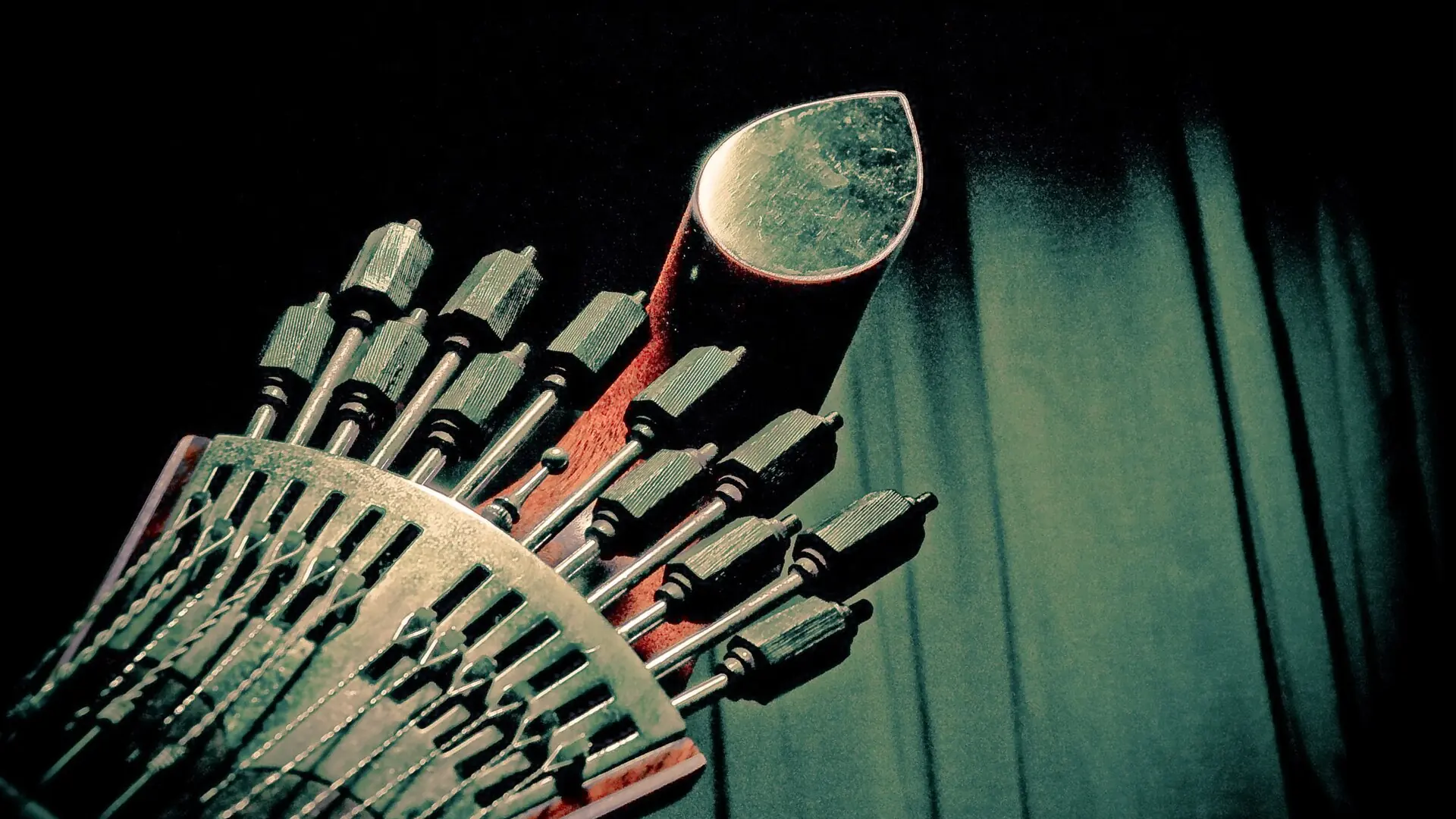
UNESCO’s description is a teardrop-bodied cittern carrying a dozen metal strings, an instrument that Portugal alone produces. Traditionally it teams up with a wire-strung acoustic guitar behind the singer. More recently the backing has swelled to a pair of guitarras, a guitar and a bass, though a studio of twelve listeners is likelier to hear the older, sparser duo.
How it is built
Wikipedia counts six courses of paired steel strings. The Lisbon type has a wider soundboard and a snail-shaped ornament over the tuners; the Coimbra type carries a teardrop motif and is usually plainer. The Coimbra guitar also has a longer scale, 470 millimetres against 445 for the Lisbon type. The instrument uses watch-key or Preston tuners, a mechanism that you can see in the fan-shaped array of screws in the photograph on this page.
Where it came from
Its ancestors are the medieval citole and the cittern, which was popular in Portugal from the Renaissance through the 18th century. Wikipedia records that the English guitar reached Portugal around 1750, after which local makers remodelled it into today’s guitarra. Those plucked, wire-strung forebears are the family the modern guitarra belongs to.
What it does in a song
Wikipedia says that in Lisbon fado the guitarra works through question-and-answer phrases and flashy improvisation. The singer states a line; the guitar replies, fills the space, and moves aside. In a small room you can follow this exchange almost like a conversation. The second guitar underneath provides the harmonic floor, while the Portuguese guitar adds the decoration and the pushback. If you listen for the rhythm of reply and answer, the music stops being background and becomes a duet.
Two tunings, two cities
Lisbon guitars are tuned to D and Coimbra guitars to C, a major second apart. Wikipedia explains that players in both traditions use the same note names by ear, which means a Coimbra guitar sounds a step lower than its written names suggest. It is a technical detail, but it shows how closely the instrument and the regional style are bound together.
Great players worth knowing
Wikipedia names Artur Paredes as a key figure of the Coimbra tradition and his son Carlos Paredes as the best-known internationally, and it describes Armandinho as highly influential in Lisbon. It lists António Chainho and Paulo Soares among later soloists. The instrument also has a solo repertoire, the guitarradas, so it is not only an accompanist. If the guitar in Alte surprises you, a few of those names are good places to start listening at home.
What to listen for in the studio
Three things. First, the attack of the strings, which is sharp in a small room. Second, the way the guitar answers each phrase of the voice. Third, the quiet: fado is built around pauses, and in a room of twelve people, with no amplification smearing the sound, the silences are as audible as the notes.
Frequently asked questions
Is it just a small classical guitar?
No. Its body is shaped like a pear and its steel strings come in doubled courses, so it sounds sharper and brighter.
Will there be one at the concert?
The listing names no instruments, so read the booking page rather than guess.
Who plays it?
Wikipedia names Artur and Carlos Paredes, Armandinho, António Chainho and Paulo Soares among its notable players.
Sources